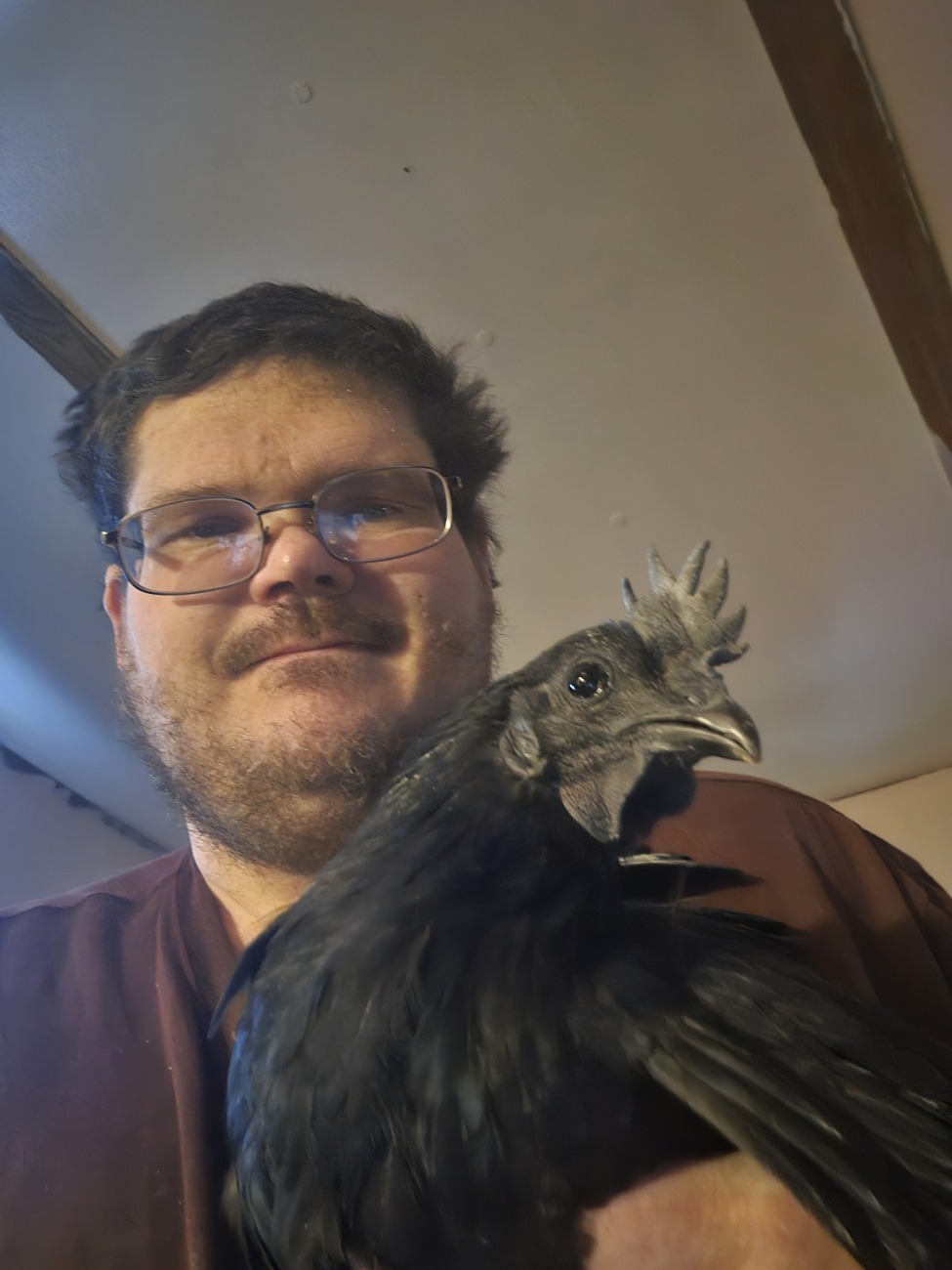
Im a poultry farmer looking for more land to use for my small but expanding poultry farm
Preferred location: Chippewa, Luce, Mackinac
Desired Transitional Agreement: Farm Seeker/Farm Owner Partnership, Lease to buy, Working arrangement with future partner
Apr 23, 2026
Desired Acreage
- 1-5 Acres
- 5-10 Acres
- 11-25 Acres
Desired Infrastructure
Desired Land Usage
Goals, Values, Vision
My future plans have accelerated significantly. Managing a flock of over 300 birds means my infrastructure and biosecurity must be airtight. My focus is now on high-efficiency scaling—moving from manual processes to the robust, automated systems I’ve been architecting. With this many birds, the NPIP certification isn't just a goal; it's the backbone of my ability to move stock safely and professionally across the region.
The Vision at Scale
My vision for a circular economy is more relevant now than ever. A 300-bird flock creates a significant amount of "output" that I can reclaim and repurpose back into the land, truly leaning into my 4R Ethos. As the flock grows, so does my capacity for philanthropy; I am now positioned to provide a much more substantial and consistent supply of protein to local Newberry organizations, making a measurable dent in local food insecurity.
Skills & Logistics
The "Systems Engineer" side of my brain is now the primary driver of the farm's success.
- Precision Nutrition: Calculating feed for 300 birds requires absolute accuracy to remain cost-effective. My work on toasted, ground legumes is no longer just a project—it’s a logistical necessity to bypass the costs and quality issues of commercial soy-based feeds.
- Automated Management: I’m relying heavily on my Docker and n8n workflows to track health, production, and genetics. You can’t manage 300 birds "by feel"—you need data, and my technical background gives me the edge to manage this population without losing the "open-book" transparency I value.
A Note on the Journey:
Going from the start of my journey on May 2, 2025, to over 300 birds by early 2026 shows just how committed I am to Nugget Farm and Hatchery. It’s a lot of noise and a lot of work, but it’s the only way to build the resilient, community-centered food system I envisioned for my family and the Upper Peninsula.
Farming Status
Current Farming Status
Full Time, Current active business plan
Farm Experience/Education
Farm employee, Farm owner
Mentoring
I am seeking mentorship
Farming Plans and Practices
Farming Method
Organic Practices, Conventional
This is how I would present my approach to our farming practices—bridging the gap between traditional methods and modern organic principles to create something that actually works for the birds and the land.
## **Our Hybrid Approach: Beyond Labels**
When people ask if we are an "organic" or "conventional" farm, my answer is usually: **"We’re a Systems-Integrity farm."** While we utilize many organic principles, we don’t let rigid labels get in the way of common sense, animal welfare, or the **4R Ethos** (Reuse, Recycle, Reclaim, Repurpose). With a flock that has grown to over **300 birds**, we’ve had to scale our practices without losing our soul.
### **1. Ethical "Free-Ranged" Management**
We’ve moved away from the industry-standard "pasture-raised" terminology in favor of **Free-Ranged**.
* **The Practice:** Our chickens, ducks, geese, turkeys, guineas, and quail aren’t just moved from one square of grass to another; they have the freedom to exhibit natural behaviors in a diverse environment.
* **The Why:** This reduces stress, naturally manages pest populations, and integrates the birds into our local ecosystem here in Newberry. It’s more than just a marketing term—it’s how we ensure the ethical treatment of every bird in the flock.
### **2. Precision Nutrition: The Legume Revolution**
One of the most unique aspects of our operation is our feed program. I’ve moved away from conventional, soy-heavy commercial feeds in favor of a custom, soy-free approach.
* **The Innovation:** We use **toasted and ground legumes** as our primary protein source. Unlike conventional cooking, toasting preserves the nutritional integrity while neutralizing anti-nutrients.
* **The Fermentation Factor:** We utilize **fermented feed** to boost probiotics and nutrient absorption. This isn't just "organic" thinking; it's biological optimization.
* **Strict Safety:** Because we run an "all-flock" environment, we maintain a strict **1% calcium limit (barn lime)** to ensure the long-term kidney health of our male birds, while providing free-choice calcium for the layers.
### **3. The Circular Economy & Soil Health**
Our "conventional" side involves high-tech management, but our "organic" side is all about the soil.
* **Closed-Loop Fertility:** With over 300 birds, we have a significant nutrient resource. We reclaim and compost all bedding and manure, cycling it back into the land to build topsoil rather than relying on synthetic fertilizers.
* **No "Onion" Policy:** We are meticulous about what goes into our system. For example, we have a strict ban on onions and other known toxins in our feed and scrap reclamation, ensuring our eggs and meat are as clean as possible.
### **4. Tech-Driven Sustainability**
This is where my background as a **Systems Engineer** meets the soil. I don't believe organic farming has to be "low-tech."
* **Data-Backed Welfare:** I use **Docker-based management tools and n8n workflows** to track bird health, growth rates, and feed conversion.
* **Transparency:** Our "open-book" policy means that anyone can see our process. We use technology to document our practices, ensuring that when we say our birds are raised humanely and sustainably, we have the data to back it up.
## **The Mission Behind the Practice**
Ultimately, whether a practice is labeled "organic" or "conventional" matters less to me than whether it is **sustainable and restorative**.
My goal is to provide a clean, high-quality protein source for my family and the Newberry community. By combining the rigorous observation of a systems engineer with the heart of a traditional farmer, I’m building a hatchery that respects the bird, the consumer, and the land in equal measure.